Our 4th Grade Homeschool Curriculum for the 2026–2027 School Year
Here’s a look at the books and resources we’ll be using for 4th grade this coming school year. While we’re excited to try a few new resources for math and science, much of our overall approach remains the same. We’ll continue to focus on living books, narration, hands-on learning, and exploring the world through geography and culture studies.
Language Arts
I like to pull from a variety of different resources for language arts. Both literature and writing are naturally integrated into our other subjects throughout the year, with a focus on oral and written narration plus sentence strategies inspired by Judith C. Hochman’s The Writing Revolution. Together, these approaches have worked wonderfully for us throughout the years.
No products found.
Vocabulary & Spelling
In the past we’ve used Patricia Cunningham’s Making Words approach to spelling because it’s more hands-on in its approach, rather than rote memorization. We’ll be moving onto Making Big Words this coming year, with a particular focus on word roots, prefixes, and suffixes.
Last school year we also tied spelling into our poetry recitations each day, and both my kids enjoyed that approach as well. It’s actually very simple: I read a poem aloud and then select words from within the poem for my kids to spell. I have mini whiteboards available if they prefer to “write” the word while spelling, or they can simply spell each word aloud. It only takes a few minutes, but it gives us a another easy opportunity to discuss spelling patterns and vocabulary every day.
Grammar & Punctuation
For grammar and punctuation, we’ll continue using Critical Thinking Co.’s Editor in Chief. Both of my girls enjoy the “editing” format much more than traditional grammar worksheets, and I’ve found that correcting mistakes in context helps them pay closer attention to their own writing.
No products found.
Creative Writing
We’re also making room for creative writing this year. My youngest daughter especially enjoys creating stories, so she’ll be working through DK’s Write Your Own Book. Here, the goal is simply to encourage creativity, rather than formal writing instruction.
No products found.
Literature
Our 4th grade literature selections will be heavily influenced by folk tales and fairy tales this coming school year as we begin exploring Europe together through the Global Explorers Club. Throughout the year, we’ll pair these stories with mapwork, notebooking, creative projects, and other hands-on activities specific to each country we’re studying.
If you’re curious which books we’ll be reading as we travel across Europe this year, I’ve shared our complete Europe reading list [HERE].
Overall, our language arts approach continues to be fairly relaxed. We read a lot, discuss what we’re reading, practice narration, and integrate writing naturally into the subjects we’re already exploring.
Math
For math, I’m taking a similar approach and pulling together a handful of resources that complement one another.
How to Be Good at Math
We’ll be using How to Be Good at Math by DK as the backbone of our scope and sequence this year. I appreciate the way it explains mathematical concepts visually and encourages children to think about why math works, not just how to solve a particular problem. There’s also a companion workbook available, which my daughter will be working through after we’ve covered each lesson together.
No products found.
No products found.
Math Antics
To reinforce new concepts, I’ve mapped lessons to corresponding Math Antics videos where available. We’ve used Math Antics as a supplemental resource for years, and I’ve consistently found it to be one of the clearest video resources available. If she needs additional practice with a particular skill, there are also worksheets available to accompany many of the videos.
Challenge Math
One area I’d like to continue strengthening this year is mathematical reasoning. To support that goal, we’ll be working through Edward Zaccaro’s Challenge Math as well.
No products found.
No products found.
Hands-On Equations & Developing Fraction Sense
We’ll also be returning to Hands-On Equations, which has been one of my favorite resources for introducing algebraic thinking to younger students. This year I’d like to spend more time working through the word problems, helping her learn to translate everyday situations into mathematical equations and solve them independently.
No products found.
Number Talks & Math Games
Of course, we’ll continue to integrate number talks and math games into our homeschool as well. Some of our go-to math games right now include PlaySmart Dice Deluxe Math Game, Zeus on the Loose, Absolute Zero, Adsumudi: Wild Ones, Outnumbered, PEMDice, and Math-Tac-Toe.
No products found.
No products found.
No products found.
No products found.
How We Organize Math
It probably looks like a lot when it’s all written out, but math has always been one of my daughter’s favorite subjects. She enjoys playing with numbers, solving puzzles, and just generally having fun with math, so having a variety of resources available helps keep that enthusiasm alive.
To keep everything organized, I created a simple spreadsheet that maps out our lessons and resources. While it’s technically arranged by day, I don’t expect us to follow it rigidly.
For example, a typical week might include a lesson or two from How to Be Good at Math, a Math Antics video, some Challenge Math exercises, and a day dedicated to Hands-On Equations and a couple of math games. Having everything laid out in one place makes it easy for me to see how the pieces fit together while still giving us plenty of flexibility.
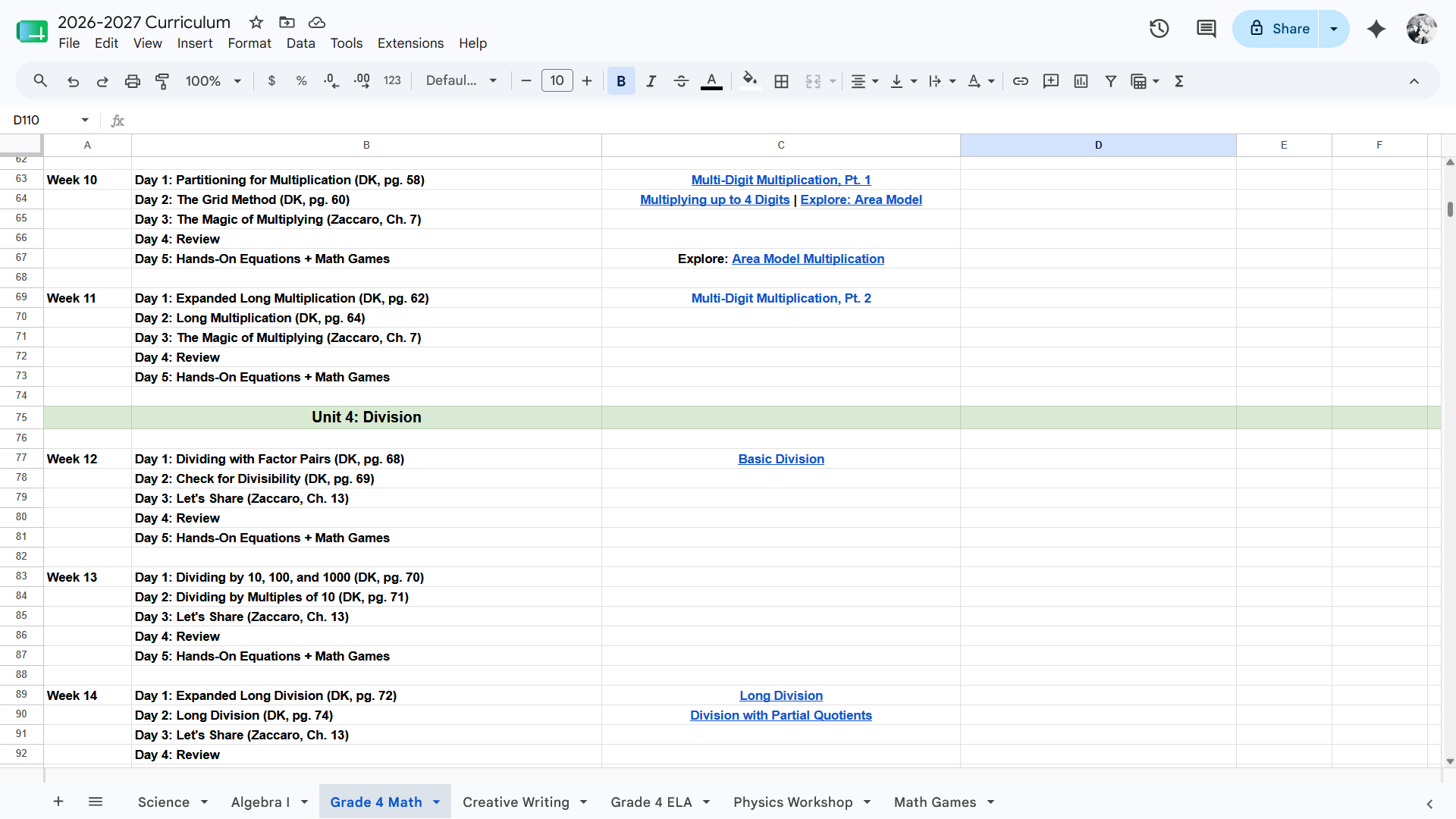
One of the things I’ve learned over the years is that planning and scheduling are two very different things. I enjoy creating a roadmap for the year, but I also know we’ll inevitably linger on some topics longer than expected and move quickly through others. The spreadsheet simply helps me keep track of where we’re headed next.
Science
Mammoth Science & Generation Genius
We’ll be using Mammoth Science as our primary scope and sequence, with the companion workbook serving as my daughter’s independent work. I wanted something that provided a solid overview of the major scientific disciplines without requiring a lot of preparation on my part, and Mammoth Science seemed like a good fit.
No products found.
No products found.
Rather than simply reading through the lessons and completing workbook pages, I’ve mapped each topic to at least one hands-on activity, experiment, educational game, or interactive exploration. I strongly believe that science is one of those subjects that tends to stick better when children can see it, touch it, build it, or experiment with it themselves.
One challenge of homeschooling children at different ages is finding ways to learn together whenever possible. To help with that, I’ve paired many of our lessons with corresponding Generation Genius videos from their middle school science series. While the videos are technically geared toward older students, I’ve found that both of my girls enjoy them, and they provide a simple way for us to explore more advanced concepts together before diving into age-appropriate follow-up activities.
For example, when we’re studying states of matter, we’ll be making oobleck and launching pop rockets. During our life science studies, we’ll be growing mold, building food chain pyramids, observing photosynthesis, and dissecting flowers. I also plan to incorporate a variety of science-themed games throughout the year, including several from the Science Ninjas series.
As with our other subjects, I’ve created a simple spreadsheet to organize everything. It helps me see how the workbook lessons, videos, experiments, and games connect together while still giving us the flexibility to move at our own pace.
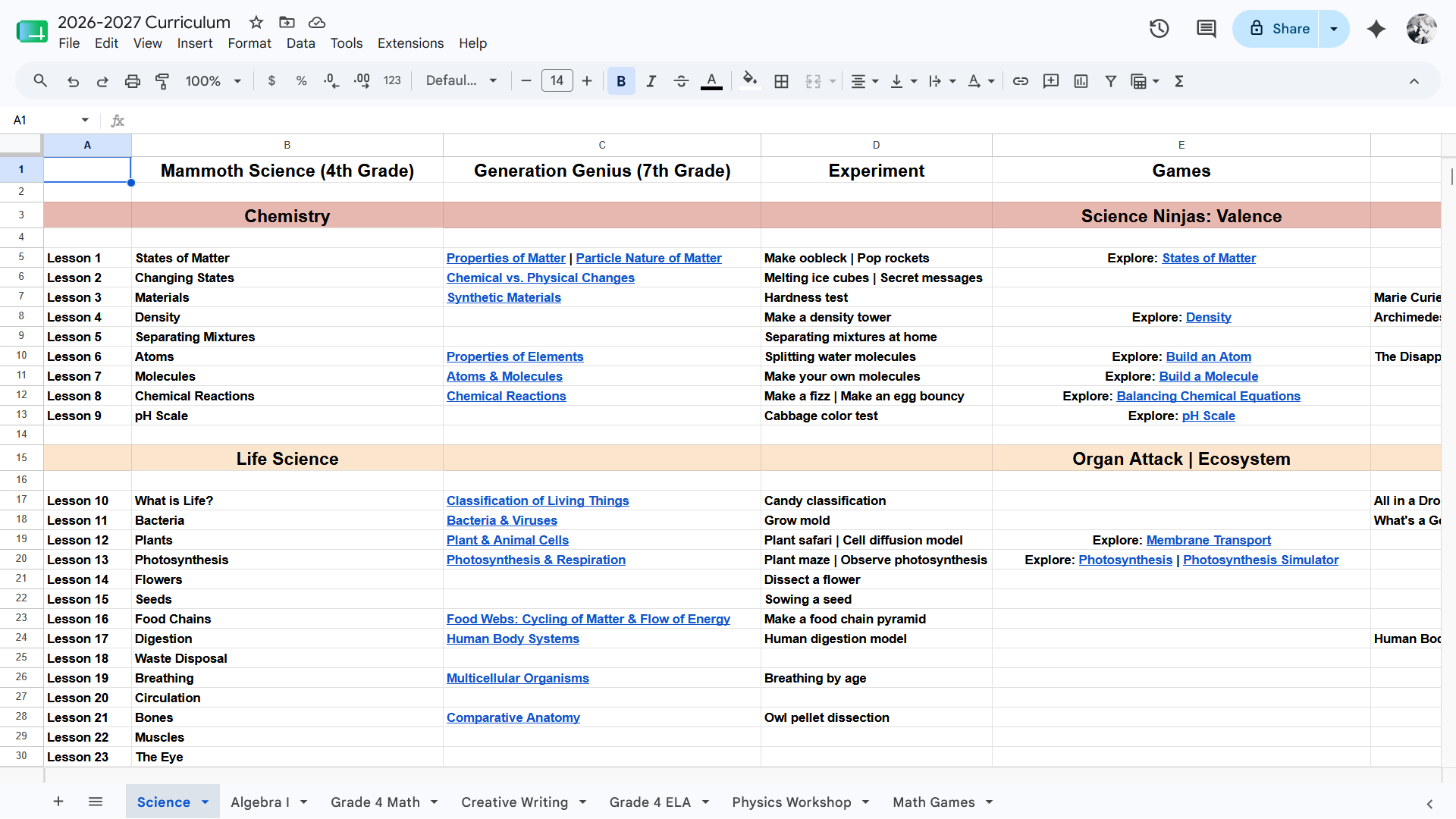
I can almost guarantee we won’t complete every activity I’ve listed. The list simply gives me a starting point and a collection of ideas to pull from as we move through the year. Many of the activities are drawn directly from the Mammoth Science workbook, while others are included in the Generation Genius videos and their accompanying lesson materials.
Physics Workshop
In addition to our regular science studies, we’ll also be tackling a year-long physics project together with the Physics Workshop kit from Thames & Kosmos.
No products found.
Since both of my girls enjoy building and experimenting, I wanted a project that would allow us to explore physics concepts together regardless of grade level.
My plan is to use Mondays as our “Make It Monday” sessions, where we’ll begin constructing that week’s model or device. Then, on Fridays, we’ll set aside time for our workshop experiments, testing our creations, making observations, and discussing the science behind what happened.
Social Studies
Social studies is probably the easiest subject for me to plan because so much of it is already woven into our family-style learning. This year, we’ll be exploring Europe together through the Global Explorers Club.
Rather than approaching geography as a collection of maps and facts to memorize, we use each country as a starting point for learning about the world and the people who live in it. Throughout the year, we’ll explore geography, culture, literature, music, art, food, history, science, and even character education through the different countries we’re studying.
One of the things I love most about this approach to cultural studies is how naturally everything connects together. A folk tale leads to a writing activity, a recipe can spark a discussion about geography and agriculture, and a science lesson can help us better understand a country’s landscape, climate, or wildlife. Instead of treating subjects as separate boxes, we’re able to see how they overlap and influence one another.
Our studies will take us across Europe, and along the way we’ll complete mapwork activities, create notebooking pages, listen to folk tales, try some new recipes, explore art projects, study famous composers, and learn about the people and places that make each country unique.
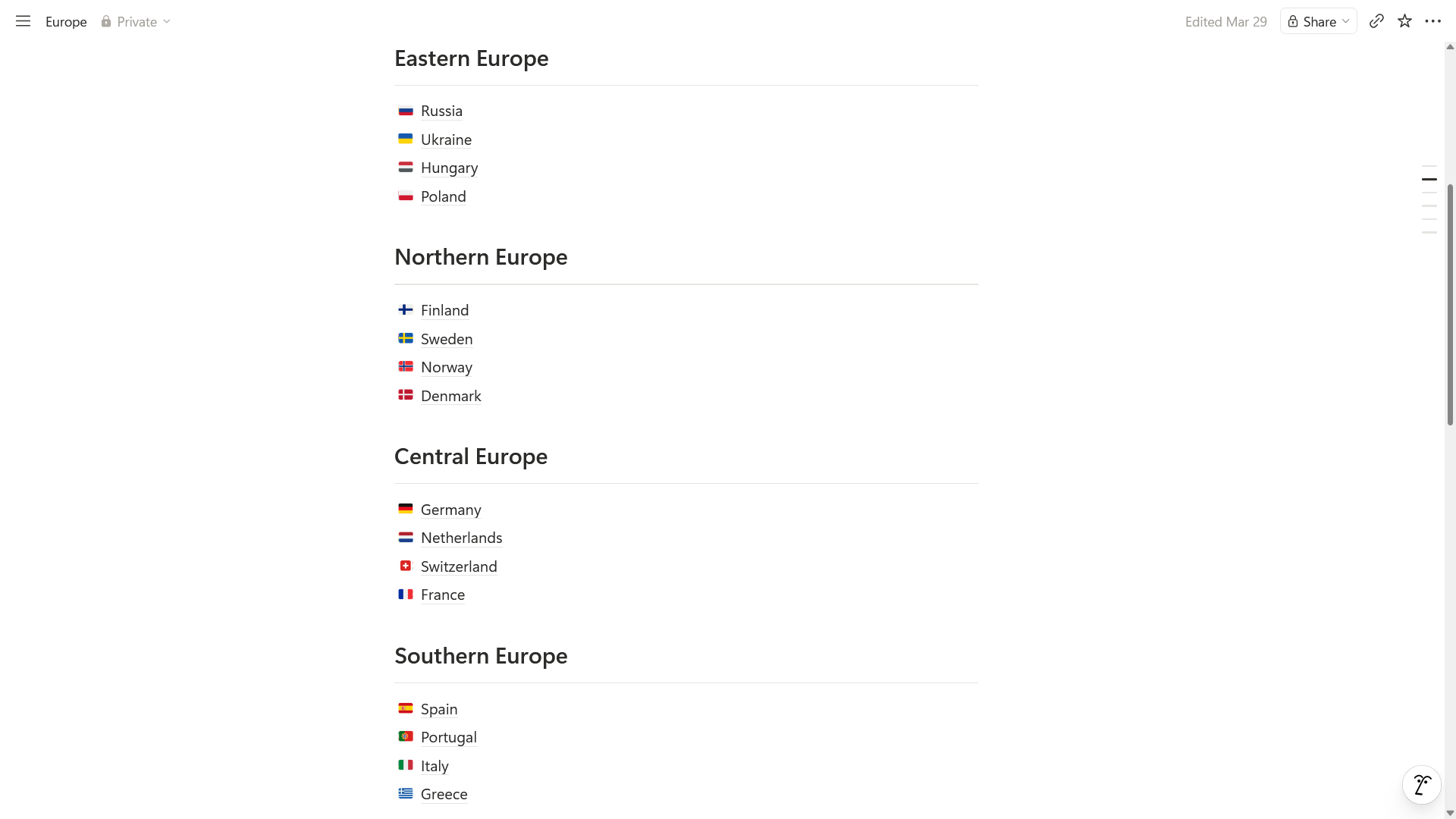
If you’d like a closer look at the resources and activities included in our Europe studies, you can learn more about the Europe Continent Study here.
Because our cultural studies serve as the backbone of much of our homeschool, many of our literature selections, writing assignments, and enrichment activities will connect directly to the countries we’re exploring.
Our Morning Basket
Many of our favorite learning experiences happen during morning basket time. This is where we gather for read-alouds, poetry, history, folk tales, and many of the books that complement our Europe studies.
Because so much of our learning this year is centered around Europe, I’ve put together a dedicated reading list featuring the folk tales, fairy tales, novels, biographies, and chapter books we’ll be reading throughout the year.
[View Our Europe Reading List]
I also shared a separate look at our complete morning basket plans, including the enrichment resources we’ll be using alongside our core curriculum.
[View Our Morning Basket Plans]
Learning Beyond the Lesson Plans
As always, these plans are simply our main starting point. Some resources will become favorites, others may quietly disappear midway through the year, and we’ll almost certainly discover a few new books and interests along the way.
Our care of the child should be governed, not by the desire ‘to make him learn things’, but by the endeavor always to keep burning within him that light which is called intelligence.
Maria Montessori
That’s one of the things I love most about homeschooling. The plans give us direction, but the goal isn’t simply to complete a checklist of lessons or finish every workbook page. The goal is to nurture curiosity, encourage questions, and keep that love of learning alive.